Adolescent Literacy Professional Development. Fully Funded by the State of Illinois.
The Illinois State Board of Education (ISBE) is collaborating with K12 Coalition to provide professional learning and implementation support services to improve evidence-based literacy instruction for educators and school leaders serving students in Grades 4-12 (upper elementary, middle, and secondary) across the State of Illinois.
Illinois Course Application with Keys to Literacy
We have reached capacity for the Keys to Adolescent Literacy course — and that is a testament to the incredible response from Illinois educators across the state. Thank you to everyone who submitted.
The form is still open. Submitting below will place you on the waitlist. We will be in touch if a spot becomes available through a cancellation, or if additional opportunities are made available down the road. We encourage you to submit — we want to make sure we can reach you if anything changes.

Who This Is For
Built for grades 4-12 educators across every subject.
This course was selected by ISBE specifically for upper elementary, middle, and secondary educators — and it was designed to be relevant regardless of what you teach.
You are eligible if you are:
- A classroom teacher in grades 4-12 in any subject area
- An instructional coach working with grades 4-12 educators
- A school or district leader supporting grades 4-12 instruction
This is not an ELA-only course. Science teachers, social studies teachers, history teachers, special education teachers, and intervention specialists are all eligible and are exactly the audience this course was built for.
What You Get
The Keys to Adolescent Literacy (KAL) course — fully funded for Illinois educators.
11 modules. Fully asynchronous. Accessible on desktop and mobile.
Your enrollment is fully funded between Keys to Literacy and the Illinois State Board of Education. The state has already allocated funding for 1,500 educator seats. When those seats are filled, registration closes.
There is no invoice. No reimbursement process. No budget approval needed. Your district does not pay. You do not pay. You register, and you have full course access.

Keys to Adolescent Literacy Course Outline
Keys to Adolescent Literacy is developed by Keys to Literacy, a division of K12 Coalition, and is grounded in more than 20 years of research and practice in evidence-based literacy instruction. The course is aligned to the Illinois Comprehensive Literacy Plan and meets the ISBE requirements for professional learning under this initiative.
The course is delivered on Talent LMS and is fully accessible on desktop and mobile devices. Technical support is available throughout the contract period.
- PART 1: Introduction to Adolescent Literacy
- PART 2: Literacy Instruction
- PART 3: Literacy Intervention
Literacy Basics
- The Science of Reading and Writing (Simple View, Reading Rope, Writing Rope, stages of reading development, how the brain learns to read)
- Five Components of Reading
- Language Components (Orthography, Morphology, Semantics, Syntax, Discourse, Pragmatics)
- Principles of Effective Teaching (including explicit instruction, gradual release of responsibility, culturally responsive literacy instruction)
- Integrating Reading and Writing Instruction (using writing to learn, comparing the ropes, models of subject-area text)
- Considerations for English Learners
What is Adolescent Literacy?
- Overview: Adolescent Literacy (defined, levels of instruction: intervention, content, disciplinary)
- Research: Evidence-Based Secondary Reading & Writing Instruction
- Core Literacy Instruction Grades 5-12
- Content & Disciplinary Literacy (defined, differences, needs of struggling adolescents)
- Teaching Content & Disciplinary Literacy (role of content teachers, instructional suggestions, challenges)
- Adolescent Motivation and Engagement in Literacy
Overview of Vocabulary Instruction
- Why teach vocabulary? (including the vocabulary-comprehension connection)
- Academic Vocabulary
- Effective Vocabulary Instruction (direct and indirect, breadth and depth)
- Vocabulary Instruction for English Learners
- Previewing Vocabulary Prior to Reading (including instructional suggestions)
- Selecting Words to Teach In-Depth (including three-tier model)
- Teaching Targeted Words In-Depth (including instructional suggestions)
- Word-Learning Templates (Frayer/Four Square, Two-Column)
- Making Connections Among Words (schema, three activities: categorizing, semantic mapping, semantic feature analysis)
- Teaching Use of Context
- Teaching Use of Word Parts (structural analysis using morphemes, word families)
- Fostering Word Consciousness
Overview of Comprehension Instruction
- Comprehension Overview (RAND reading comprehension model, factors affecting comprehension, considerations for English learners, and dialect differences)
- Vocabulary, Background Knowledge, and Comprehension
- Access to High-Quality Grade-Level Text
- Analyze Text, Teach Close Reading
- Making Inferences
- Metacognition, Comprehension Monitoring
- Comprehension Strategies:
- Graphic organizers, top-down topic webs
- Main ideas
- Note taking
- Summarizing
- Answering and generating questions
Text Structure to Support Reading & Writing
- Understanding Text Structure in Reading and Writing (multiple levels of text structure)
- Three Types of Text (Narrative, Informational, Argument)
- Patterns of Organization and Transitions
- Paragraph Structure
- Sentence Structure
- Instructional Suggestions
Overview of Writing Instruction
- What do we know about writing? (teaching principles, research overview, AI, and writing instruction)
- Writing Frameworks: The Writing Rope, The Not-So-Simple-View of Writing
- Writing in the Content Areas (using writing to learn, role of content teachers)
- Types of writing assignments – quick writes, responding to text, teacher-generated prompts)
- Mentor Text as Models for Writing
- Stages of the Writing Process (Think, Plan, Write, Revise.; awareness of task, audience, purpose)
- Strategy Instruction and Scaffolds:
- Think Stage: gathering information and ideas into notes
- Plan Stage: graphic organizer to plan structure
- Write Stage: writing templates
- Revise Stage: revising for content and conventions
- Revision: Teacher and Peer Feedback
- Using a Writing Assignment Guide (WAG)
Supporting Learning Through Discussion
- Discussion to Support Learning (including discussion formats)
- Planning for Discussion (preparing questions, discussion norms)
- Academically Productive Talk
- Facilitating Discussion (including teachers and student talk moves)
- Discussion Activities (common activities, Socratic Seminar)
Advanced Word Study and Fluency
- Teaching Advanced Phonics and Word Study in Grades 5-12 (progression across grades, students with word reading difficulties)
- Introduction to Phonics, Advanced Word Study, and Fluency
- Multisyllabic Words (including a routine for reading and spelling longer words, emphasizing morphemes over syllables)
- Teaching Morphemes (instructional suggestions for prefixes, suffixes, roots)
- A Closer Look at Syllables, Syllable Division, and the Schwa Vowel Sound
- Spelling Instruction for Grades 5-12
Integrating Literacy into Content Instruction
- Examples of Vocabulary, Comprehension, Text Structure, Discussion, and Writing Applied to Classroom Text and Other Sources
- Application: Use your Content Lessons and Sources
- Identify and incorporate a before, during, and after literacy instruction task
- Generate a discussion activity and a writing task
Adolescent Students with Literacy Difficulties
- Older Students Who Struggle with Literacy (misconceptions, motivation, and emotional consequences, tiered instruction)
- Causes of Literacy Difficulty
- Difficulty with Reading, Writing
- Supporting Struggling Readers and Writers in the General Education Classroom
- Overview: Effective Intervention Instruction
- Reading Intervention: Vocabulary and Comprehension
- Reading Intervention Suggestions: Decoding and Fluency
- Suggestions for Writing Intervention
- A Closer Look at Dyslexia (including the reading brain)
- A Closer Look at Executive Functions
- A Closer Look at English Learner Challenges
- Additional Suggestions
Data-Driven Reading Intervention
- Intervention Instruction Informed by Assessment (assessment and MTSS, a secondary literacy instruction model)
- Screening and Diagnostic Assessment, Grades 5-12
- Types of Assessments, Assessment Terminology
- Assessment Across the Year (including using progress monitoring)
- Analyzing Assessment Data: Matching Students to Interventions
- Analyzing Data: School, Grade, Teacher Levels
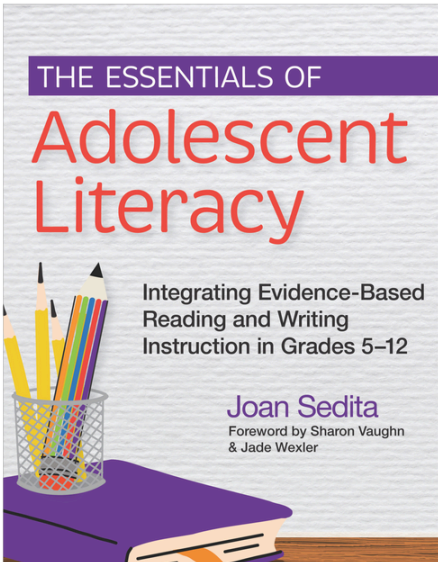
Book: Essentials of Adolescent Literacy
Written by Joan Sedita—author of the Keys to Adolescent Literacy professional learning course and the bestselling book The Writing Rope: A Framework for Explicit Writing Instruction in All Subjects—the chapters in The Essentials of Adolescent Literacy are aligned with the training course modules. The book serves as a companion resource for both online and live training.
Through this book, readers gain an insight into the unique needs of adolescent learners and learn evidence-based practices for teaching all aspects of literacy in grades 5-12. It also provides essential information about effective literacy interventions supported by assessment data.
Join the waitlist
We have reached capacity for the Keys to Adolescent Literacy course — and that is a testament to the incredible response from Illinois educators across the state. Thank you to everyone who submitted.
The form is still open. Submitting below will place you on the waitlist. We will be in touch if a spot becomes available through a cancellation, or if additional opportunities are made available down the road. We encourage you to submit — we want to make sure we can reach you if anything changes.