
New Adolescent Literacy Guide
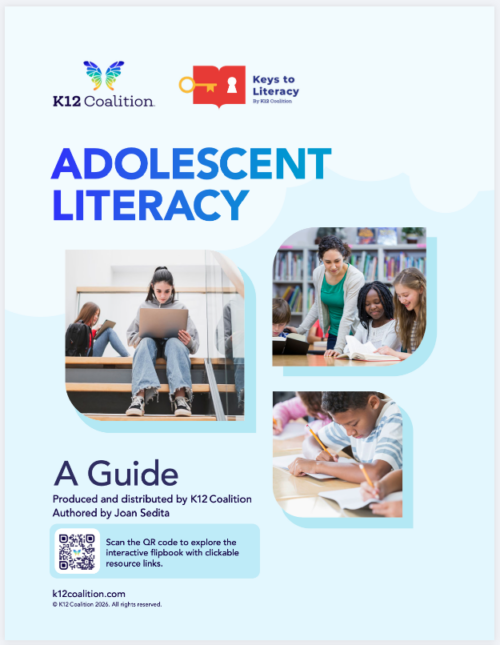
Many students leave elementary grades without grade-level reading and writing skills. Literacy difficulties that emerge in the elementary years may persist into later grades or, in some cases, first appear during adolescence. Students who lack-grade-level reading and writing skills are at a disadvantage for academic achievement.
However, over the past fifteen years, literacy initiatives in many school districts and states have focused primarily on beginning reading instruction in grades K–5—and in some cases, only K–3. The good news is that a shift is beginning to occur. State policymakers, school and district administrators, and even the general news media are increasingly recognizing the needs of adolescent learners. This shift is reflected in the emergence of organizations like the Nevada Adolescent Literacy Network and the Arizona Adolescent Literacy Network as well as in recent articles such as:
- Grade 3-8 Students Need Updated Literacy Skills Supports, Report Says (K-12DIVE)
- Schools Overhauled Reading Programs. Older Students Are Being Left Behind (EdSurge)
- When Older Students Can’t Read: How This Middle School Is Tackling Literacy (Education Week)
- Reading Skills of 12th Graders Hit a New Low (New York Times)
- State Reading Laws Focus on K-3. What About Older Students Who Struggle? (Education Week)
In addition, several states have passed or are actively considering legislation that targets adolescent literacy, including Indiana, New Mexico, and Mississippi (Education Week, 2025).
Educators Need Information
It is critical for educators who work with adolescent learners to understand how reading and writing abilities develop across the upper elementary and secondary grades. They must also be familiar with the instructional concepts, practices, and challenges that are especially relevant for grades 5–12.
I recently authored Adolescent Literacy: A Guide, produced and distributed by K12 Coalition. This free guide draws on my experience, as well as that of my colleagues at Keys to Literacy, to share what we have learned about adolescent literacy over the past 20 years. It highlights research-based strategies for teaching the content and disciplinary literacy skills students need to read, write, and engage in discussion across all subject areas, as well as ways to support struggling readers and writers.
This free guide includes sections that provide essential summary information on the following topics:
- What adolescent literacy is and why it is important to teach literacy to adolescents
- Levels of adolescent literacy instruction (basic, content, disciplinary)
- A secondary reading instruction model
- Adolescent literacy research
- The science of reading and adolescent learners
- The connection between reading and writing
- Core literacy instruction in grades 5-12
- Intervention supports for struggling adolescents
- Reading assessment, including a screening and diagnostic framework
- Adolescent literacy leadership
- Strategies for motivating and engaging adolescent learners
Adolescent Literacy Resources from Keys to Literacy
Book and Course
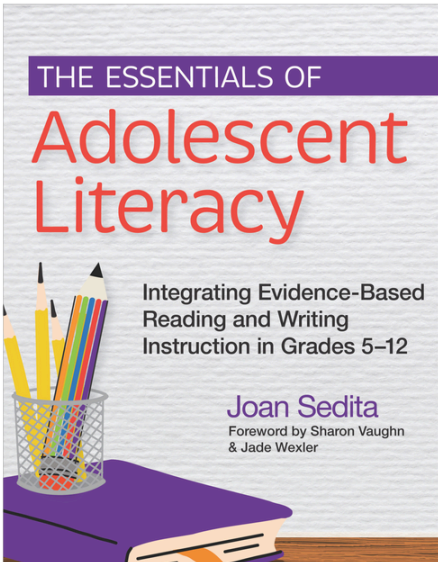
In writing Adolescent Reading: A Guide, I drew on content from my book Essentials of Adolescent Literacy: Integrating Evidence-Based Reading and Writing Instruction in Grades 5-12 (2026, Paul H. Brookes Publishing) and the related Keys to Adolescent Literacy professional development course. Information about the course and the book, including book study questions, is available on the Keys to Literacy website.

Conference
Keys to Literacy is sponsoring the first annual Adolescent Literacy – Unlocked! virtual conference on May 1, 2026. The conference is an opportunity for educators to learn more about adolescent literacy from national experts.
Additional free resources I have written or recorded related to adolescent literacy include:
- Free edWeb Recorded Webinar: Essentials of Adolescent Literacy
- White paper: Disciplinary Literacy: Integrating Literacy Instruction in All Subjects, Grades 6-12.
- Video: Adolescent Literacy: Components of Literacy Instruction in an MTSS Model
- Literacy Lines blog posts:
- Do Adolescent Learners Need Fluency Instruction? (March 5, 2026)
- Middle and High School: School-Wide Literacy Planning (December 8, 2025)
- Essentials of Adolescent Literacy: Author Q and A (November 5, 2025)
- Discussion to Support Learning: Part 1 (January 7, 2025), Part 2 (February 4, 2025, Part 3 (March 4, 2025)
- Reading Assessment, Grades 5-12 (November 25, 2024)
- Motivating & Engaging Adolescents to Read (October 4, 2023)
- Providing Reading Interventions Grades 5-9 (May 5, 2022)
Additional Adolescent Literacy Resources
- Research Guide: Improving Adolescent Literacy: Effective Classroom and Intervention Practices (Kamil et al., 2008, Institute of Education Sciences)
- Research Guide: Reading Next (Biancarosa and Snow, 2004)
- Research Guide: Writing Next (Graham & Perin, 2008, Carnegie Corporation)
- Research Guide: Teaching Secondary Students to Write Effectively (Graham et al., 2016, Institute of Education Sciences)
- Research Guide: Writing to Read – Evidence for How Writing Can Improve Reading (Graham & Hebert, 2010)
- Research Guide: Providing Reading Interventions for Students in Grades 4-9 (Institute of Education Sciences)
- Website: AdLit.org
- Guide: What Content-Area Teachers Should Know About Adolescent Literacy (National Institute of Child Health and Human Development)
- Resource Guide: Adolescent Literacy Resource Menu – A Guide for Instructional Leaders (The Meadows Center
Joan Sedita
 Joan Sedita is the founder of Keys to Literacy and author of the Keys to Literacy professional development programs. She is an experienced educator, nationally recognized speaker and teacher trainer. She has worked for over 35 years in the literacy education field and has presented to thousands of teachers and related professionals at schools, colleges, clinics, and professional conferences.
Leave a Reply