
Do Adolescent Learners Need Fluency Instruction?

Fluency, along with phonemic awareness, phonics, vocabulary, and comprehension, is one of the five essential components of reading identified by the National Reading Panel (2000). The panel found compelling evidence that instruction aimed at improving fluency is critical for both comprehension and overall reading success. Fluency is often described as the bridge between word recognition and comprehension. It is best observed during oral reading. For older students, fluency also plays a key role in maintaining motivation to read. This raises an important question: Do adolescents require explicit instruction in fluency, or is fluency instruction necessary only in the elementary grades?
Fluency Defined
Fluency is the ability to read text—across varying levels of complexity—accurately, at an appropriate rate, and with automaticity. It also includes reading with prosody, or expressive reading that reflects phrasing, intonation, and emotion. What are these components, and how do they work together to create fluent reading?
- Rate refers to how quickly students read text and is often measured in WCPM (words correct per minute). Proficient middle and high school readers typically read grade-level text at a rate of at least 145–150 WCPM. However, speed alone is not sufficient; students must also read accurately and understand the meanings and structures of words and sentences.
- Accuracy is the ability to correctly read the words on the page. Comprehension suffers when students cannot accurately read at least 95% of the words in a given text.
- Automaticity is the ability to recognize words quickly and effortlessly without consciously decoding them. Adequate rate and accuracy contribute to automaticity. When students read words automatically, they free cognitive resources that would otherwise be spent on decoding, allowing more mental energy to be devoted to understanding larger chunks of text. Because working memory has limited capacity, frequent pauses to decode words can interfere with comprehension (Reed, 2022, citing Baddeley, 2012).
- Prosody refers to expressive reading that reflects phrasing and intonation. Students demonstrate prosody by pausing between meaningful phrases and at the ends of sentences, as well as by incorporating appropriate tone, volume, emphasis on key words, and rhythm when reading aloud.
Fluency, Motivation, and Adolescent Readers
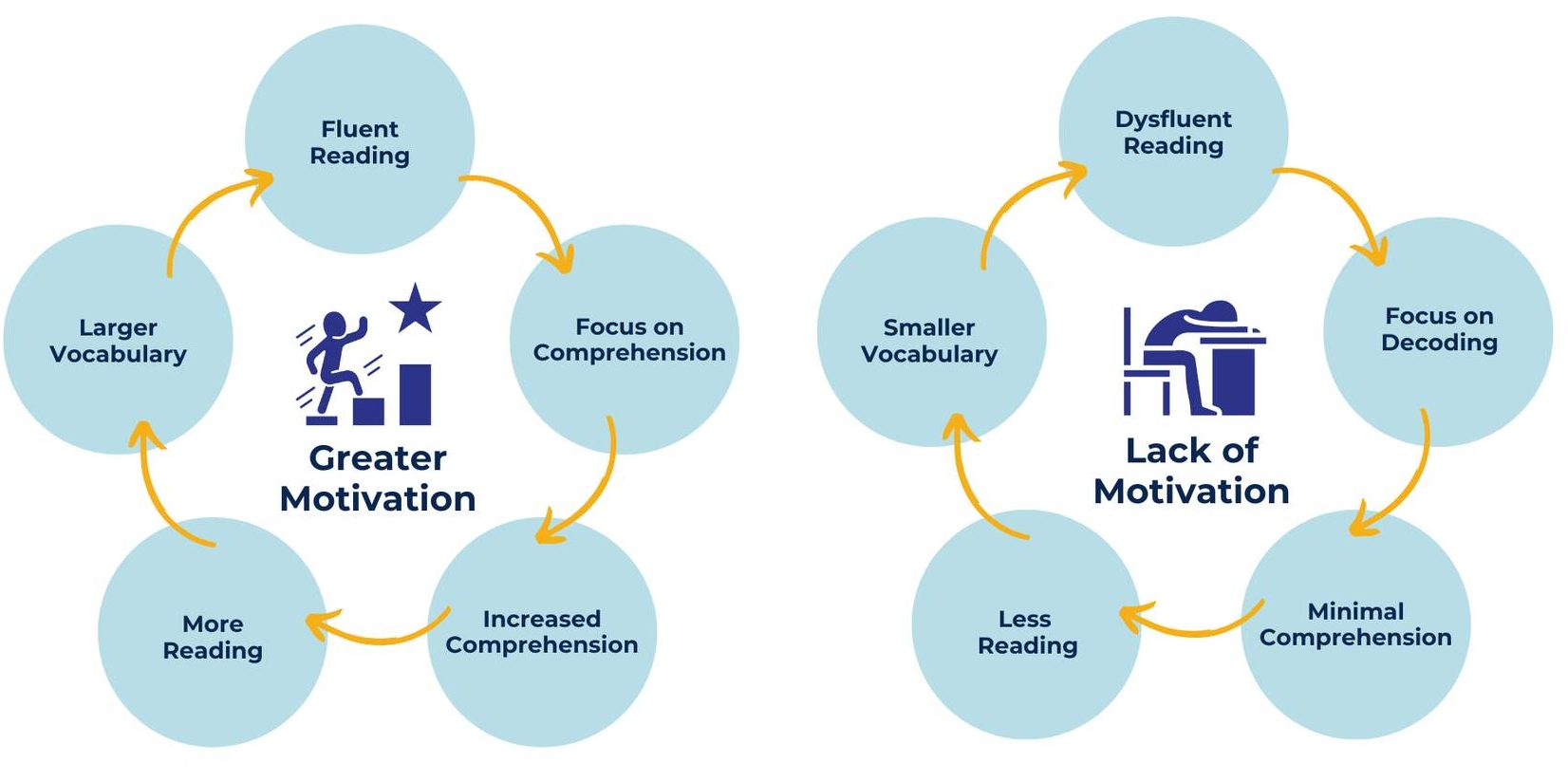
Fluency plays an important role in helping older students remain motivated as readers. When students read fluently, they tend to read more frequently, which helps them expand their vocabulary knowledge. Increased vocabulary, in turn, improves comprehension, which further strengthens motivation to read. Conversely, students who lack fluency tend to read fewer words and develop smaller vocabularies. This leads to less reading overall and reduced motivation to read. A lack of reading fluency is therefore a major reason why some older students experience difficulty with reading.
Teaching Adolescent Students With Grade-Level Fluency
The benchmark fluency rate for the end of Grades 5 and 6 is 146 WCPM (Hasbrouck & Tindal, 2017). Middle and high school students who can read at a rate of at least 145–150 WCPM with 95% or higher accuracy—and who comprehend grade-level text—typically do not require additional fluency instruction. Regular reading, both in and outside of school, will support continued growth in fluency and help students manage increasingly complex texts. Teachers across all subject areas should ensure that students regularly engage with challenging and complex texts. Consistent exposure helps students maintain and further develop their fluency as reading demands increase each year.
Fluency Intervention for Students With Reading Difficulties
A lack of fluency is often a root cause of reading difficulties in adolescents and requires targeted intervention. Some students struggle because they have not yet developed automatic word recognition. Although they may possess sufficient word analysis skills to decode multisyllabic words, the process remains laborious, slowing their reading rate and distracting them from comprehension. Other students may still lack sufficient phonics and word study skills, making decoding even more difficult.
What’s the difference between fluent and disfluent readers?
Fluent Readers:
- Can automatically decode words with at least 95% accuracy and self-correct when mispronunciations occur.
- Typically read grade-level texts at a rate of at least 145 words correct per minute, adjusting their pace based on the text’s difficulty.
- Pay attention to punctuation and group words into meaningful phases when reading aloud.
- Read aloud with appropriate prosodic expression and intonation.
- Effectively combine fluency and comprehension skills during reading.
Disfluent Readers:
- Read slowly and haltingly, often spending excessive time decoding words.
- When encountering unfamiliar words, they may skip them, guess their pronunciation, or attempt to sound out individual letters.
- Frequently mispronounce words.
- Often read aloud in a flat, monotone voice, neglecting prosodic expression.
- Typically read in a choppy, word-by-word manner, disregarding punctuation.
- Have limited comprehension because their attentional focus is on word reading.
What does effective fluency intervention instruction look like?
The research guide Providing Reading Interventions for Students in Grades 4–9 (Vaughn et al., 2022) emphasizes the importance of purposeful, fluency-building activities to help disfluent adolescents read more effortlessly. The report suggests strategies such as repeated reading of the same passage, providing a specific purpose for each reading, allocating instructional time to reading with prosody, and wide reading, summarized below.
Repeated Reading
Research strongly supports the use of repeated oral reading to help students to develop fluency, especially for those with reading difficulties. Consider the following instructional strategies for adolescents (Boardman et al., 2008; Hasbrouck & Hougen, 2012; Lee & Yoon, 2017; Stevens et al., 2019; Vaughn et al., 2022):
- Vaughn and colleagues (2022) note that repeated reading can be effective in building fluency with adolescents, but caution that “if not structured well, it can be perceived as a dull and discouraging task” (p. 12). To avoid this, provide a clear purpose for each repeated reading instead of focusing just on increasing speed. For example, when rereading the same passage, students might answer questions for the first read, identify unfamiliar words for the second, or reflect on the text’s meaning for a final read.
- Offer feedback and prompt students to focus on their accuracy and rate during reading.
- Emphasize accuracy and expression, not just speed.
- Reading alongside a model is more effective than independent silent reading. Use partner reading, where a more fluent reader models fluent reading for a less fluent peer. Partners can take turns reading aloud to support each other.
- Choral reading in small groups allows students to practice reading aloud with support before reading independently.
- Whenever possible, select texts for repeated reading that are connected to subject-area content students are currently studying.
- Encourage students to track their progress toward fluency goals and reflect on their growth.
Reading With Prosody
Pauses, tempo, and emphasis on different words help readers better understand what they are reading. Fluency interventions should draw students’ attention to the features of prosody by modeling why it matters. Vaughn and colleagues (2022) suggest that teachers first read a short paragraph aloud without expression and without observing punctuation. Then, they should reread the same passage, this time demonstrating prosody. After both readings, teachers and students can discuss which version was easier to understand. During fluency practice, teachers should encourage students to pause at commas, stop at periods, raise or lower their voices for question marks, and express appropriate emotion while reading.
Wide Reading Practice
Teachers should allocate time each week in intervention classes for students to engage in wide reading (Vaughn et al.,2022). This involves reading a variety of texts on different topics and in different writing styles. These texts should be at the upper end of students’ instructional reading level and aligned with grade-level content. Wide reading not only improves fluency but also exposes students to new vocabulary, content, and text structures. To increase engagement, choose high-interest topics relevant to older students, and when possible, allow students to select the texts they read aloud for fluency practice.
Low Accuracy Rate
For students whose accuracy rates are below 95%, this may indicate that they have not yet developed sufficient phonics knowledge to decode words effectively, particularly multisyllabic words. In addition to the suggestions described above, these students may need targeted, explicit phonics instruction.
In Summary
Adolescents in upper elementary, middle, and high school who can read grade-level text at a rate of 145–150 words correct per minute with 95% accuracy generally do not require explicit fluency instruction. As long as they continue to read high-quality texts both in and out of school, their fluency will continue to develop, allowing them to focus more fully on constructing meaning while reading. In contrast, older students who have not yet developed proficient fluency skills require targeted intervention that focuses on fluency and, in some cases, phonics and advanced word study. Some fluency-building activities commonly used in elementary grades are also appropriate for older students, provided that their unique developmental and academic needs are taken into account.
Resource
The text in this post draws from two chapters in Essentials of Adolescent Literacy: Integrating Evidence-Based Reading and Writing Instruction in Grades 5-12 by Joan Sedita (2023, Brookes Publishing) and is also aligned with the Keys to Adolescent Literacy professional development course.
References
- Baddeley, A . D. (2012). Working memory: Theories, models, and controversies. Annual Review of Psychology, 63.
- Boardman, A . G., Roberts, G., Vaughn, S., Wexler, J., Murray, C. S., & Kosanovich, M. (2008). Effective instruction for adolescent struggling readers: A practice brief. RMC Research Corporation, Center on Instruction.
- Hasbrouck, J., & Hougen, M. C. (2012). Fluency instruction. In M. C. Hougen & S. M. Smartt (Eds.), Fundamentals of literacy instruction and assessment, Pre-K–6 (pp. 147–172). Paul H. Brookes Publishing Co.
- Hasbrouck, J., & Tinda l, G. (2017). An update to compiled ORF norms (Technica l Report No. 1702). Behavior l Research and Teaching, University of Oregon.
- Lee, J., & Yoon, S.Y. (2017). The effects of repeated reading on reading fluency for students with reading disabilities. Journal of Learning Disabilities, 50(2.
- National Reading Panel. (2000). Report of the National Reading Panel: Teaching children to read: An evidence- based assessment of the scientific research literature on reading and its implications for reading instruction (NIH Publication No. 00-4769). U.S. Government Printing Office.
- Reed, D. K. (2022). Fluency instruction for adolescents: Evidence from research to practice. Learning Disabilities: A Contemporary Journal, 20(2).
- Stevens, E. A ., Park, S., & Vaughn, S. (2019). A review of summarizing and main idea interventions for struggling readers in grades 3 through 12: 1978–2016. Remedial and Special Education, 40(3).
- Vaughn, S., Gersten, R ., Dimino, J., Taylor, M. J., Newman-Gonchar, R ., Krowka, S., Kieffer, M. J., McKeown, M., Reed, D., Sanchez, M., St. Martin, K., Wexler, J., Morgan, S., Yañez, A ., & Jayanthi, M. (2022). Providing reading interventions for students in Grades 4–9 (W WC 2022007). Nationa l Center for Education Eva luation and Region l Assistance (NCEE), Institute of Education Sciences, U.S. Department of Education.
Joan Sedita
 Joan Sedita is the founder of Keys to Literacy and author of the Keys to Literacy professional development programs. She is an experienced educator, nationally recognized speaker and teacher trainer. She has worked for over 35 years in the literacy education field and has presented to thousands of teachers and related professionals at schools, colleges, clinics, and professional conferences.
Leave a Reply