
Teaching Reading to English Learners: Research and Practical Recommendations
The Summer 2026 edition of American Educator included an article by Linda Cavazos and Claude Goldenberg titled “The Road to Reading for English Learners.” The authors begin by posing an important question: Do findings from reading research, often referred to as the science of reading, apply to students known as English Learners (ELs), emergent bilinguals, or multilingual learners?
Their answer is yes. Research has demonstrated “that what we know about how children acquire literacy when they know the language they are learning to read in is just as relevant for students who are learning the language as they are learning to read and write it” (p. 1). However, the authors emphasize that reading instruction for ELs must also include instruction that supports English language development.
Over the past year, I have had the opportunity to update information about effective reading instruction for ELs in two of my books related to Keys to Literacy courses: Keys to Beginning Reading (Second Edition, 2025) for grades K-5 and The Essentials of Adolescent Literacy (2026) for grades 5-12. This post shares instructional suggestions from these resources that align with those offered by Cavazos and Goldenberg.
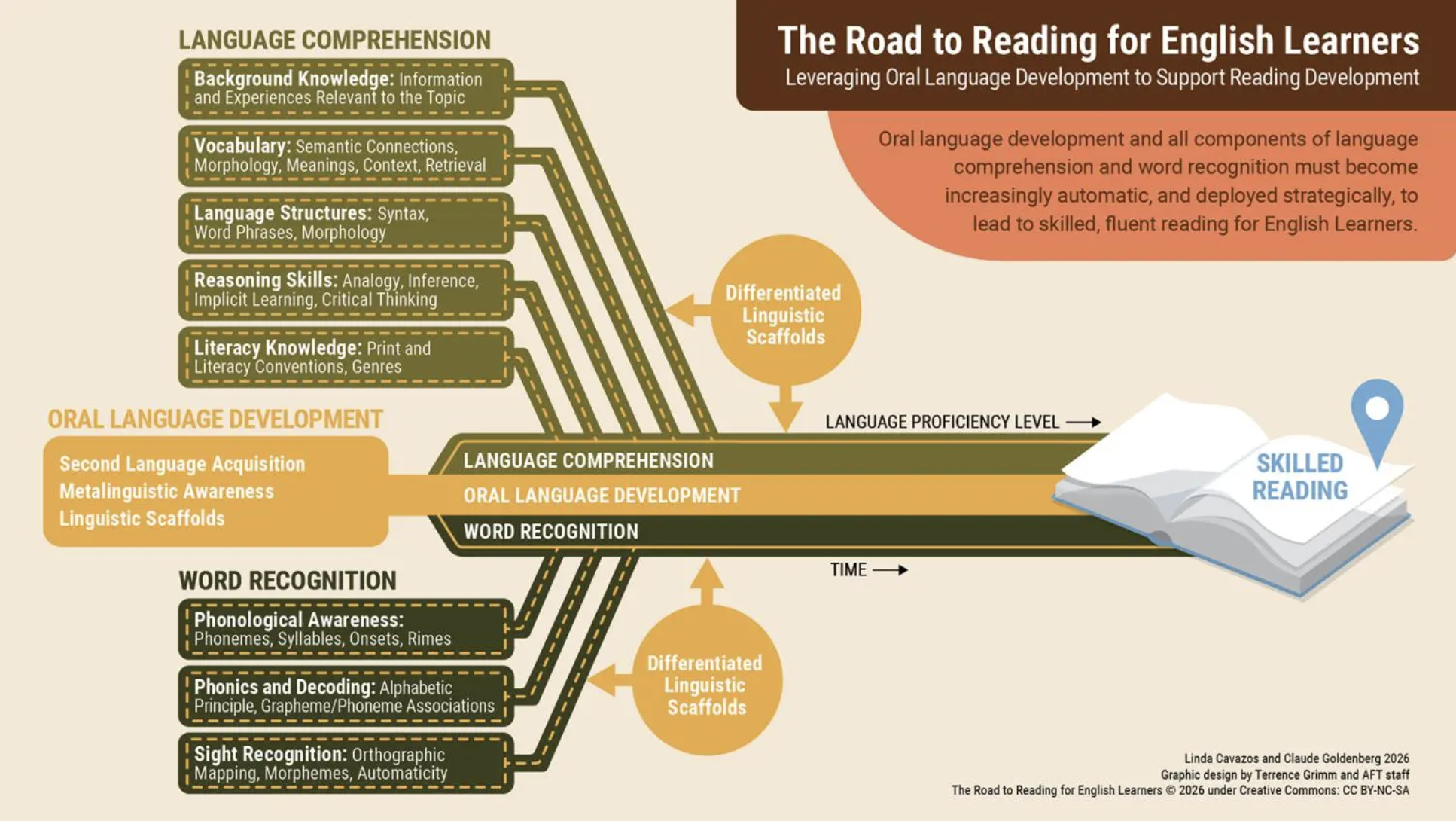
Cavazos and Goldenberg developed a graphic that reconceptualizes the Reading Rope metaphor developed by Hollis Scarborough (2001). Their version, titled The Road to Reading for English Learners, is shown below. The graphic emphasizes the essential role of oral language development in helping ELs develop proficiency in spoken and written English. It also highlights the importance of providing linguistic scaffolds to support their learning.
Teaching Reading to ELs
Not all students whose first language is not English experience difficulty developing English literacy skills. Many acquire the sounds and patterns of English relatively quickly and incorporate them into their everyday language use. However, a significant number of ELs encounter challenges as they develop the language and literacy skills needed for academic success.
Home Language Reading Ability Matters
English learners enter school with varying literacy skills. Some may be able to read and write in their native language, whereas others may only hold oral language skills in their native language. Likewise, some English learners enter school with basic reading and writing skills in English, whereas others present very limited English proficiency skills.
Educators should be aware of students’ reading accuracy and fluency in their home language. Students who have developed automatic word recognition and decoding skills in their home language may be better positioned to learn to read in English. The same principle applies to comprehension strategies and subject-area knowledge. ELs who have learned to apply reading strategies in their home language and possess relevant background knowledge can draw on these strengths to support their reading comprehension in English.
In Literacy Foundations for English Learners: A Comprehensive Guide to Evidence-Based Instruction, Elsa Cárdenas-Hagan (2020, pp. 4–5) emphasizes:
“English learners bring with them prior knowledge, experiences, and strengths related to language and learning that educators must find ways to identify and build upon.”
Beginning Reading Instruction: The Five Components of Reading and English Learners
Learning to read in a language one is simultaneously learning involves many of the same processes as learning to read in a language one already knows. Important differences include the writing systems, spelling patterns, and relationships between sounds and letters in the two languages (Goldenberg, 2020).
ELs in the elementary grades benefit from instruction in the same five components of reading identified by the National Reading Panel: phonemic awareness, phonics, fluency, vocabulary, and comprehension (NICHD, 2000).
Drawing on comprehensive reviews of reading research, Cárdenas-Hagan (2020, pp. 40–41) explains that instruction in these five components is essential for ELs but should include adjustments that address their language-learning needs:
“The same five components of literacy instruction that are important for monolingual English speakers are essential for second language learners, with some slight adjustments… The use of native language for the development of second language vocabulary skills is recommended. Examples include understanding cognates and word parts that are similar across languages and can assist with vocabulary development, which may also positively effect comprehension skills. It is important for educators to understand the oral language proficiency levels of ELs and incorporate language opportunities during instruction.”
Findings from the National Literacy Panel on English Learners
The benefits of teaching ELs the five essential components of reading were documented as early as 2006 in Developing Literacy in Second-Language Learners, a report from the National Literacy Panel on Language-Minority Children and Youth (August & Shanahan, 2006).
Key findings from the report include:
- Instruction in the five components of reading is beneficial. Instruction that provides substantial coverage of phonemic awareness, phonics, fluency, vocabulary, and text comprehension has clear benefits for language-minority students (p. 3).
- Reading instruction alone is not sufficient. Teaching these components is necessary but not sufficient for developing proficiency in reading and writing in English. Oral English proficiency is also critical, yet it is often overlooked in instruction (p. 4).
- Home language proficiency supports English literacy development. Oral language proficiency and literacy skills in a student’s first language can facilitate literacy development in English (p. 5).
- Individual differences matter. Differences among students significantly influence their development of English literacy skills (p. 5).
Instructional Recommendations
In 2014, the Institute of Education Sciences published the practice guide Teaching Academic Content and Literacy to English Learners in Elementary and Middle School (Baker et al., 2014). The guide offers four recommendations for supporting the academic language and literacy development of ELs.
These recommendations extend beyond the five components of reading to address the broader language skills students need for academic success, including listening, speaking, reading, and writing in English. The four recommendations are:
- Teach a set of academic vocabulary words intensively across several days using a variety of instructional activities.
- Integrate oral and written English language instruction into subject-area teaching.
- Provide regular, structured opportunities to develop written language skills.
- Provide small-group instructional intervention to students struggling with literacy and English language development.
Additional Suggestions for Elementary English Learners
The second edition of Keys to Beginning Reading (Sedita, 2025) offers the following instructional suggestions, drawn from several sources (August & Shanahan, 2006; Coleman & Goldenberg, 2010; Gersten et al., 2007; Lopez & Paez, 2020; Torgesen et al., 2007)
- Recognize that literacy development in a student’s home language provides an important foundation for learning to read and write in English.
- Provide evidence-based literacy instruction that benefits all learners, while differentiating instruction to address ELs’ specific language and literacy needs.
- Provide structured opportunities for extended, meaningful discussions about academic content between ELs and proficient English speakers. Collaborative academic tasks involving students with varying levels of English proficiency can be particularly beneficial.
- Create a language-rich classroom environment in which teachers use supportive communication strategies and instructional scaffolds. Make content more accessible by incorporating visuals, graphic organizers, summaries, and other supports that reduce unnecessary language demands.
- Establish consistent classroom routines that help ELs understand expectations and feel comfortable participating in learning activities.
- Provide extensive and varied vocabulary instruction throughout the school day. Include explicit, in-depth instruction in essential academic and content-specific vocabulary, as well as commonly used words, phrases, and expressions.
- Make the development of formal academic English a central instructional goal, beginning in the primary grades.
- Use a varied, well-structured instructional approach that incorporates small-group activities, shared book reading, language and literacy exercises, and opportunities for meaningful social interaction.
- Create a supportive environment in which ELs feel comfortable participating and practicing their developing English skills.
- Screen elementary students for reading difficulties and closely monitor their progress. Use appropriate English-language measures to assess phonological processing, letter knowledge, word reading, and text reading. Interpret assessment results in light of students’ English proficiency and use the findings to identify those who need additional support.
- Provide intensive, small-group reading interventions for ELs at risk for reading difficulties. Target instruction to students’ identified needs across the five components of reading.
When Language Transferability May Be Helpful
Some ELs can transfer literacy knowledge and skills from their home language to English. The extent to which this transfer occurs depends on several factors:
- Whether the home language uses an alphabetic writing system.
- The degree to which its sound–letter correspondences and spelling patterns are similar to those in English.
- The student’s level of literacy proficiency in the home language.
For example, Spanish and English share several useful linguistic connections, although important differences also exist. Many English words have Latin origins, and Spanish and English share numerous cognates—words with similar forms and meanings. Examples include alarm/alarma, bicycle/bicicleta, center/centro, decide/decidir, elephant/elefante, ocean/océano, paper/papel, telephone/teléfono, and secret/secreto.
There are also similarities and differences in the sound systems of the two languages. Spanish has approximately 24–29 phonemes, depending on the dialect and analysis used, compared with approximately 44 in English. Many letter–sound correspondences are shared across the two languages, while others differ or transfer only partially. Understanding these similarities and differences can help teachers build on students’ existing language knowledge while providing explicit instruction in unfamiliar English sound and spelling patterns.
Understanding the Needs of Secondary English Learners
The Essentials of Adolescent Literacy book (Sedita, 2026) provides additional information about the literacy needs of adolescent ELs in middle and high schools.
These students are expected to meet the same academic standards in content-area classrooms as their native English-speaking peers. As a result, they face the dual challenge of developing proficiency in listening, speaking, reading, and writing in English while simultaneously using these emerging skills to learn increasingly complex academic content (Short & Fitzsimmons, 2007).
For this reason, literacy instruction in the secondary grades must continue to support English language development alongside reading and writing instruction. Educators should also recognize that students may develop conversational English proficiency well before they achieve the level of academic English proficiency needed for success in school. This gap can persist for several years, making it essential to understand each student’s level of English proficiency and provide appropriate instructional support (Cavazos & Goldenberg, 2026).
Schoolwide adolescent literacy initiatives and literacy plans should explicitly address these challenges and identify ways to support ELs across content-area classrooms.
The same five components of reading that are essential for beginning readers also provide a foundation for reading intervention with older ELs who struggle with literacy. However, intervention should target the specific reading skills in which individual students have gaps. There is no one-size-fits-all approach to addressing the literacy needs of adolescent ELs.
When planning instruction and intervention, teachers should consider students’ proficiency in English and their home language, prior literacy experiences, knowledge of academic subject matter, expectations and experiences related to schooling, opportunities to use English outside school, and whether they are newcomers to the United States or have attended U.S. schools for several years.
Making Academic Content Accessible to English Learners
While adolescent ELs are developing English proficiency, they must also keep pace with academic learning across subject areas. Content-area teachers play an important role in making grade-level instruction accessible without unnecessarily reducing the complexity of the content students are expected to learn.
One way to accomplish this is through linguistic scaffolding. Examples include previewing unfamiliar vocabulary before reading; strategically drawing on students’ home language, including the use of cognates to support vocabulary learning; providing summaries of key ideas from texts; and using word banks and sentence starters to support speaking and writing.
The Sheltered Instruction Observation Protocol (SIOP) is an instructional model that integrates language development with content instruction to make academic learning more accessible to ELs (Echevarria et al., 2016). Several instructional practices associated with the SIOP model are described below. Although designed to support ELs, many of these practices also represent effective instruction that benefits all students.
- Build Background Knowledge: Teachers help students connect new concepts to their existing knowledge by previewing vocabulary, using visuals, and providing relevant context. As they tap into what students already know, teachers can identify misconceptions and fill gaps in background knowledge.
- Provide Comprehensible Input: Teachers present content in ways that make it accessible and understandable to students. Strategies include using visuals, graphic organizers, charts, hands-on demonstrations, modeling, role-playing, gestures, and pantomime to clarify concepts. Teachers can also make information more accessible by adjusting their language, such as restating information, summarizing key points, and paraphrasing. The goal is to support students’ understanding despite language barriers.
- Incorporate Interaction: Teachers provide opportunities for students to develop conversational and academic language through interactions with teachers and peers about the content they are learning. These opportunities include partner and small-group discussions, as well as collaborative reading and writing tasks. Through these interactions, English learners can practice new vocabulary and language structures, ask questions, and elaborate on their own and others’ ideas.
- Incorporate Practice and Application: Teachers provide a variety of activities that enable students to practice and apply the content knowledge and language skills they are learning. Activities may include group assignments, partner work, writing tasks, creative projects, and discussions that give students opportunities to use new knowledge and language in meaningful ways.
In Closing
Research makes it clear that English learners benefit from the same evidence-based reading instruction that supports all students, but they also need intentional support for English language development. Effective instruction builds on the linguistic knowledge, literacy skills, and experiences students bring to the classroom while providing the scaffolds they need to access increasingly complex academic content. Whether in elementary or secondary classrooms, the goal is to help English learners develop strong reading and writing skills, become proficient in academic English, and achieve success across all subject areas. By recognizing both the commonalities and the unique needs of English learners, educators can provide instruction that supports their full potential as readers, writers, and learners.
Additional Instructional Suggestions
Additional, more detailed instructional suggestions can be found in two of my previous posts:
- Phonics Instruction for ELs May 7, 2024
- Vocabulary Instruction for English Language Learners June 6, 2023
Additional Resources
- Research Guide: Double the Work – Challenges and Solutions to Acquiring Language and Academic Literacy for Adolescent English Language Learners (Carnegie Corporation)
- Research Guide: Effective Literacy and English Language Instruction for English Learners in the Elementary Grades (Gersten et al., 2007, Institute of Education Sciences)
- Research Guide: Teaching Academic Content and Literacy to English Learners in Elementary and Middle School (Baker et al., 2014, Institute of Education Sciences)
- Article: English Language Learners and the Five Essential Components of Reading Instruction (Beth Antunez, Reading Rockets)
- Website: Reading 101 for English Language Learners (Colorin Colorado)
- Video: What Do We Need to Do to Support Our Multilingual Learners? (Dr. Elsa Cardenas-Hagan, Utah State Board of Education).
- Article: Developing Literacy in Second-Language Learners (Diane August, 2010, Timothy Shanahan, Journal of Literacy Research)
- Video: Achieving Equity for English Learners with SIOP (Jana Echevarria)
References
- August, D., & Shanahan, T. (Eds.). (2006). Developing literacy in second-language learners: Report of the National Literacy Panel on Language-Minority Children and Youth. Lawrence Erlbaum Associates.
- Baker, S., Lesaux, N., Jayanthi, M., Dimino, J., Proctor, C. P., Morris, J., Gersten, R., Haymond, K., Kieffer, M. J., Linan-Thompson, S., & Newman-Gonchar, R. (2014). Teaching academic content and literacy to English learners in elementary and middle school (NCEE 2014-4012). National Center for Education Evaluation and Regional Assistance (NCEE), Institute of Education Sciences, U.S. Department of Education.
- Cárdenas-Hagan, E. (2020). Literacy foundations for English learners: A comprehensive guide to evidence-based instruction. Paul H. Brookes.
- Cavazos, L., & Goldenberg, C. (2026). The road to reading for English learners. American Educator, Summer 2026. https://www.aft.org/ae/summer2026/cavazos_goldenberg
- Coleman, R., & Goldenberg, C. (2010). What does research say about effective practices for ELLs? Kappa Delta Pi Record, 46(2).
- Echevarria, J., Vog t, M. E., & Short, D. (2016). Making content comprehensible for English learners: The SIOP model (5th ed.). Pearson.
- Goldenberg, C. (2020). Reading wars, reading science, and English learners. Reading Research Quarterly, 55(S1), 1–28. https://doi.org/10.1002/rrq.304
- Goldenberg, C. & Cardenas-Hagan, E. (2023). Literacy research on English learners: Past, present, and future. The Reading League Journal, January/February, 2023. https://edsource.org/wp-content/uploads/2023/05/Literacy-Research-on-English-Learners.pdf
- Lopez, L., & Paez, M. (2020). Teaching dual language learners: What early childhood educators need to know. Paul H. Brookes.
- National Institute of Child Health and Human Development (NICHD). (2000). Report of the National Reading Panel: Teaching children to read: An evidence-based assessment of the scientific research literature on reading and its implications for reading instruction (NIH Publication No. 00-4769). U.S. Government Printing Office.
- Scarborough, H. S. (2001). Connecting early language and literacy to later reading (dis)abilities: Evidence, theory, and practice. In S. Neuman & D. Dickinson (Eds.), Handbook for research in early literacy (pp. 97–110). Guilford Press.
- Sedita, J. (2025). Keys to beginning reading. Keys to Literacy.
- Sedita, J. (2026). The essentials of adolescent literacy: Integrating evidence-based reading and writing instruction in grades 5-12. Paul H. Brookes.
- Short, D., & Fitzsimmons, S. (2007). Double the work: Challenges and solutions to acquiring language and academic literacy for adolescent English language learners—A report to Carnegie Corporation of New York. Alliance for Excellent Education.
- Torgesen, J. K., Houston, D. D., Rissman, L. M., Decker, S. M., Roberts, G., Vaughn, S., Wexler, J., Francis, D. J., Rivera, M. O., & Lesaux, N. (2007). Academic literacy instruction for adolescents: A guidance document from the Center on Instruction. RMC Research Corporation, Center on Instruction.
Joan Sedita
 Joan Sedita is the founder of Keys to Literacy and author of the Keys to Literacy professional development programs. She is an experienced educator, nationally recognized speaker and teacher trainer. She has worked for over 35 years in the literacy education field and has presented to thousands of teachers and related professionals at schools, colleges, clinics, and professional conferences.
Leave a Reply