
The Writing Rope: A Diagnostic Framework for Formative Writing Assessment
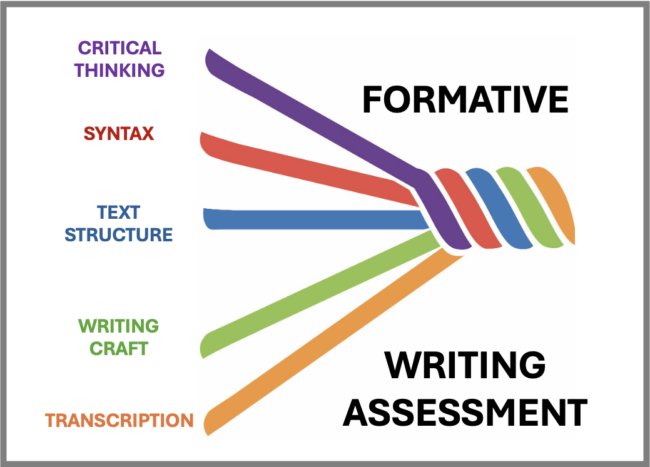
Assessment of student writing is an essential component of developing students’ writing abilities. Although writing assessment can serve a variety of purposes, an important primary goal should be to inform instruction and improve students’ writing skills. This post focuses on formative writing assessment and offers suggestions for how the Writing Rope framework (Sedita, 2019, 2023) can support it.
There are three main types of writing assessment:
1. Curriculum-Based Measurement (CBM-W): These are formal, standardized assessments that provide quantitative scores. It uses brief, timed writing tasks to measure Total Word Written (TWW), Correctly Spelled Words (CSW), and Correct Writing Sequences (CWS) for basic mechanics. CBM-W primarily focuses on writing fluency and productivity rather than higher-order aspects of writing quality.
2. Formal Standardized Assessments: These assessments are designed to evaluate written language ability and provide standardized, norm-referenced data. They allow educators to compare a student’s writing performance to that of peers, identify potential writing difficulties, and make high stakes decisions, such as determining eligibility for special education services. Typically administered by psychologists, speech-language pathologists, and other school personnel, these assessments evaluate how effectively a student can express ideas in writing. While they offer a snapshot of performance at a single point in time, they provide limited feedback and are not designed to directly improve writing skills.
3. Formative Writing Assessment: This involves the diagnostic use of assessment to inform teaching and learning. Unlike formal standardized assessments, formative writing assessment is embedded within instruction and is aimed at improving students’ writing.
Research indicates that formative writing assessment practices have a positive effect on students’ writing, particularly when they include feedback-based approaches (Graham, Harris, & Hebert, 2011; Graham, Hebert, Harris, 2015; Graham et al., 2016). These practices align with broader educational research showing that formative assessment and feedback are among the most effective instructional practices (Hattie, 2009, 2012; Greenstein, 2010). Formative assessment is effective in writing because it helps students understand what they have done well, what needs improvement, and how to improve. Graham, Harris, and Hebert (2011) explain:
“Formative assessments allow teachers to gauge the effectiveness of their instructional practices, modify instruction as needed, and provide students with feedback on writing strengths and areas in need of further development. These assessments can be administered in a variety of ways in the classroom, including teachers assessing students’ writing, students assessing their own writing, and peers assessing others’ writing.” (p 5)
Research Supporting Formative Assessment for Writing
The research report Informing Writing: The Benefits of Formative Assessment (Graham, Harris, & Hebert, 2011) was the first meta-analysis to examine the effects of formative assessment on students’ writing performance. The report concluded, “All of the recommendations presented in Informing Writing are based on strong empirical evidence. The findings are clear: Formative writing assessment makes a difference in how well students convey thoughts and ideas through text.” (p. 7)
The article Formative Assessment and Writing: A Meta-analysis (Graham, Hebert, & Harris, 2015) presents findings from a meta-analysis of studies involving students in Grades 1 through 8. It reports that classroom-based formative assessment that provides feedback on students’ written products or their progress in learning writing skills or strategies leads to postivie gains in writing. The most effective practices were feedback-based approaches—including teacher feedback, peer feedback, and self-assessment—with teacher feedback showing a substantial effect size of approximately 0.87.
The article Research-Based Writing Practices and the Common Core (Graham, Harris, & Santangelo, 2015) outlines evidence-based practices for writing instruction in kindergarten through Grade 8. Drawing on both a meta-analysis of intervention studies and a meta-synthesis of qualitative research, it emphasizes the importance of ongoing feedback. The authors highlight formative assessment as essential for monitoring students’ development as writers and for adjusting instruction to meet both group and individual needs.
The research guide Teaching Secondary Students to Write Effectively (Graham et al., 2016) presents findings from a meta-analysis of writing instruction studies for Grades 6 through 12. One key recommendation is to use formative assessment of student writing to inform instruction and feedback.
Using The Writing Rope as a Formative Assessment Tool
Students’ writing drafts can be reviewed and analyzed to identify strengths and areas for improvement across various writing skills, strategies, and techniques. Teachers do not need to assess every aspect of a student’s writing; instead, they can focus on one or two specific areas aligned with particular state standards (e.g., sentence construction or introductions to informational writing). Alternatively, they may take a more holistic approach by examining multiple components of writing.
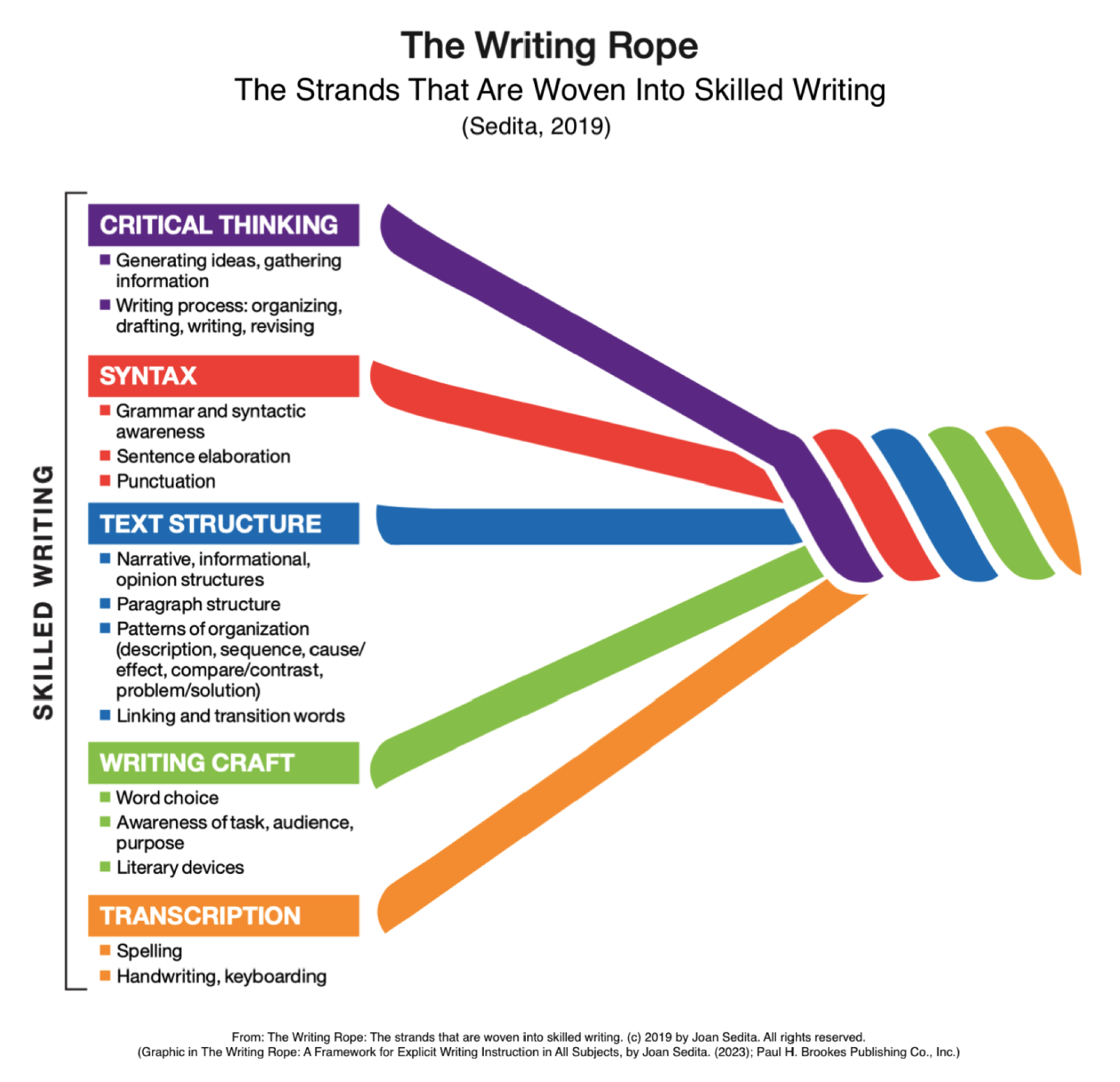
The Writing Rope framework (Sedita, 2019, 2023) can serve as an organizing tool for analyzing student writing. It organizes the skills and strategies required for proficient writing into five interconnected components, represented as strands in a rope, summarized below. (For additional information about the Writing Rope, read the article The Writing Rope: The Strands That Are Woven Into Skilled Writing (Sedita, 2019), my August, 2022 blog post New Book: The Writing Rope, or the free, recorded webinar The Writing Rope: A Framework for Evidence-Based Writing Instruction.)
Critical Thinking: This strand includes multiple skills and strategies needed to write about text and use writing as a tool for learning, such as note taking and summarizing. It also addresses strategies related to the stages of the writing process.
Syntax: This strand focuses on sentences, the building blocks of written communication. Syntax—the study and use of grammar and the arrangement of words, phrases, and clauses—plays a key role in both reading and writing.
Text Structure: This strand addresses the organization of different types of writing (narrative, informational, and argument), paragraph structure, patterns of organization, and the use of transition words and phrases to connect ideas and signal patterns of organization. Text structure supports both comprehension and writing skills.
Writing Craft: This strand emphasizes the skills, techniques, and stylistic choices that make writing engaging and effective. It includes word choice, voice, and the use of literary devices, as well as consideration of task, audience, and purpose.
Transcription: This strand focuses on foundational skills such as spelling, handwriting, and keyboarding, which are essential for translating thoughts into written language.
These strands help teachers organize their observations of students’ strengths and needs, as well as the feedback they provide. The process begins with collecting a writing sample, which may come from any subject and include routine classroom assignments, whether short or extended, or prompts designed specifically for assessment. The next step is to analyze the sample by evaluating the student’s writing abilities across the strands of the Writing Rope. A set of guiding questions can support this analysis, using the framework as a diagnostic tool. Teachers can then use this information to guide instructional decisions and provide targeted feedback, either for individual students or for the whole class when common areas of need emerge. A set of questions is provided at the end of this post (Sedita, 2026).
In summary, the Writing Rope is an effective tool for formative assessment because it breaks writing into meaningful components and connects assessment directly to instruction. This approach enables teachers to provide specific feedback, support targeted instruction, and guide student revision.
The Writing Rope Framework: Analyzing Student Writing
Joan Sedita, 2026
Overall: Does this writing sample reflect grade-level writing ability? What positive feedback could you give the student about their writing?
Transcription Skills: What do you notice about the student’s spelling and handwriting?
Writing Craft:
Task/Audience/Purpose: Did the student complete the assigned task? Did they consider the audience and purpose when writing?
Word Choice: Did the student use precise, varied, and engaging vocabulary?
Literary Devices: Did the student incorporate any literary devices such as figurative language, allusion, or hyperbole?
Text Structure:
Overall Structure: Did the student include an introduction and conclusion? Are the ideas and information in the body organized logically?
Paragraph Structure: Are the paragraphs well-structured?
Patterns of Organization: Which pattern(s) of organization did the student use (e.g., description/explanation, sequence, cause and effect, compare and contrast, problem and solution)?
Transitions: Did the student use grade-appropriate transition words and phrases?
Syntax: What is the overall quality of the sentences? Are there any sentence fragments or run-on sentences? Is punctuation used correctly?
Critical Thinking:
Writing Process: Is there evidence that the student engaged in prewriting or revision?
Generating Ideas, Gathering Information: To what extend did the student integrate information from text or other sources into the writing piece?
References:
- Graham, S., Harris, K. R., & Hebert, M. (2011). Informing writing: The benefits of formative assessment (Carnegie Corporation Time to Act Report). Alliance for Excellent Education.
- Graham, S., Harris, K.R., & Santangelo, T. (2015). Research-based writing practices and the Common Core: Meta-analysis and meta-synthesis. The Elementary School Journal 115 (4). (pp. 498-522
- Graham, S., Hebert, M., & Harris, K. R. (2015). Formative assessment and writing: A meta-analysis. The Elementary School Journal, 115(4), 523–547.
- Graham, S., Bruch, J., Fitzgerald, J., Friedrich, L., Furgeson, J., Greene, K., Kim, J., Lyskawa, J., Olson, C.B., & Smither Wulsin, C. (2016). Teaching secondary students to write effectively (NCEE 2017-4002). Washington, DC: National Center for Education Evaluation and Regional Assistance (NCEE), Institute of Education Sciences, U.S. Department of Education.
- Greenstein, L. (2010). What teachers really need to know about formative assessment. Alexandria, VA: Association for Supervision and Curriculum Development.
- Hattie, J. (2009). Visible learning: A synthesis of over 800 meta-analyses relating to achievement. Routledge.
- Hattie, J. (2012). Visible learning for teachers: Maximizing impact on learning. Routledge.
- Sedita, J. (2019). The writing rope: The strands that are woven into skilled writing. Keys to Literacy.
- Sedita, J. (2023). The Writing Rope: A framework for explicit writing instruction in all subjects. Paul H. Brookes Publishing Co.
- Sedita, J. (2026). Adolescent literacy: Integrating evidence-based reading and writing instruction in grades 5-12. Paul H. Brookes Publishing Co.
Joan Sedita
 Joan Sedita is the founder of Keys to Literacy and author of the Keys to Literacy professional development programs. She is an experienced educator, nationally recognized speaker and teacher trainer. She has worked for over 35 years in the literacy education field and has presented to thousands of teachers and related professionals at schools, colleges, clinics, and professional conferences.
Leave a Reply