
The Simple View of Reading and Four Types of Readers
The first chapter of the recently published second edition of Keys to Beginning Reading (Sedita, 2025), along with the accompanying Keys to Beginning Reading professional learning course, provides an overview of the science of reading (SOR). This overview includes several seminal models that help explain the competencies and skills students must develop to become proficient readers. One of these models is the Simple View of Reading (Gough & Tunmer, 1986). This post focuses on that model, as well as a related framework that identifies four types of readers within a four-quadrant structure.
The term science of reading (SOR) refers to a comprehensive body of scientific knowledge and research drawn from the fields of education, cognitive and developmental psychology, and neuroscience. It explains how individuals learn to read and informs best practices for effective reading instruction (Petscher et al., 2020; Seidenberg et al., 2020; The Reading League). Research related to writing is also encompassed within SOR. It is important for educators to recognize that SOR is not a curriculum, a program, or a single component of literacy instruction, such as phonics.
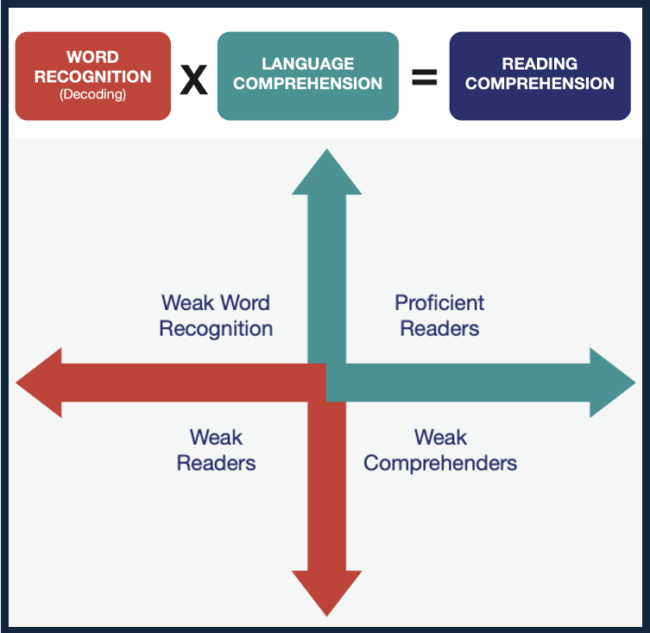
The Simple View of Reading (Gough & Tunmer, 1986) is often referenced when discussing SOR. This model proposes that reading comprehension depends on two essential components: word recognition and language comprehension. Students must be proficient in both areas for successful reading comprehension to occur. Automatic word recognition—often referred to as decoding—enables fluent reading. Language comprehension involves sufficient vocabulary knowledge and syntactic awareness (an understanding of English grammar) to make sense of spoken language.
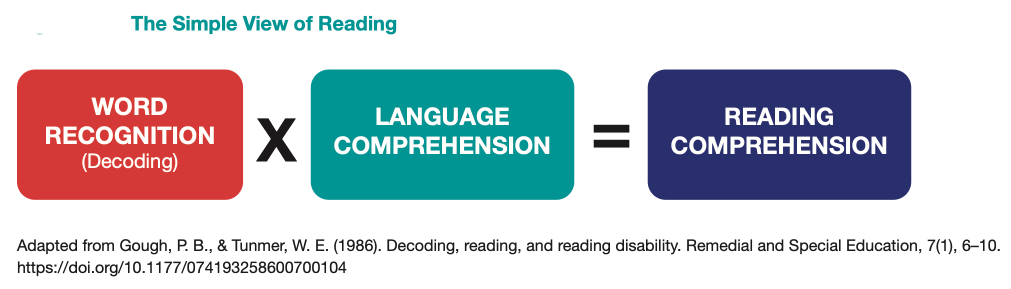
The Simple View is often represented as a formula in which the two components are multiplied rather than added. Each component—word recognition and language comprehension—is measured on a scale from 0 to 1, with 1 indicating maximum proficiency. A product of 1 (1 × 1) predicts highly proficient reading comprehension, whereas a product of 0 indicates no comprehension ability. For example, a student with strong word recognition (1) and strong language comprehension (1) is predicted to demonstrate proficient reading comprehension. In contrast, a student with no word recognition skills (0), even if they have strong language comprehension (1), will have a predicted reading comprehension score of 0, meaning they will be unable to comprehend written text.
Types of Readers: Four Quadrants
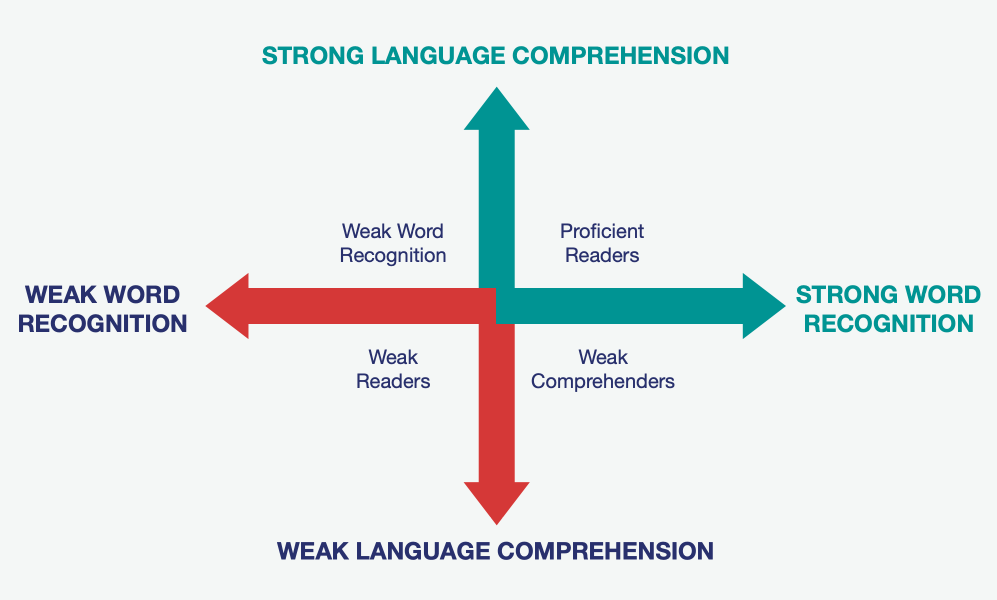
Using the Simple View as a framework, students can be grouped into four categories based on their strengths and weaknesses in word recognition and language comprehension (Catts et al., 2006; Cain, 2016), as illustrated in the graphic above and described below.
Proficient Readers: These students demonstrate strong word recognition and language comprehension skills. They typically read at or above grade level. Core reading instruction in the elementary grades across all components is generally sufficient to support their continued progress.
Weak Readers: These students experience difficulties with both word recognition and language comprehension. They benefit from targeted intervention that addresses phonics, fluency, vocabulary, and comprehension.
Readers with Weak Word Recognition: These students have strong language comprehension but weak word recognition skills. Their decoding difficulties interfere with reading comprehension, which would otherwise be strong. Students with dyslexia often fall into this category. They benefit from intervention focused on phonemic awareness, phonics, and fluency. Continued development of vocabulary and comprehension is also important to prevent regression into the weak readers category.
Weak Comprehenders: These students demonstrate strong word recognition but weak language comprehension. They are sometimes referred to as “word callers” because they can decode text without understanding its meaning. These students benefit from intervention focused on vocabulary development and comprehension strategies.
Both the Simple View of Reading and the Four Quadrants frameworks provide valuable insight into how reading skills develop in the early grades and why some students experience difficulty learning to read across grade levels. These frameworks can be used to inform decisions based on data from screening, diagnostic, and progress-monitoring assessments, as well as to guide instructional planning.
References:
Cain, K. (2016). Reading comprehension development and difficulties: An overview. Perspectives on Language and Literacy, 42(2), 9–16.
Catts, H. W., Adlof, S. M., & Weismer, S. E. (2006). Language deficits in poor comprehenders: A case for the simple view of reading. Journal of Speech, Language, and Hearing Research, 49(2), 278–-293.
Gough, P. B., & Tunmer, W. E. (1986). Decoding, reading, and reading disability. Remedial and Special Education, 7(1), 6–-10.
Joan Sedita
 Joan Sedita is the founder of Keys to Literacy and author of the Keys to Literacy professional development programs. She is an experienced educator, nationally recognized speaker and teacher trainer. She has worked for over 35 years in the literacy education field and has presented to thousands of teachers and related professionals at schools, colleges, clinics, and professional conferences.
Joan, how would this play out in a secondary intervention classroom with the students who fall into the readers with weak word recognition needing phonemic awareness? I support intensive reading for our Tier2 and T3 students in 7th and 8th grade across the district and would really love to know what else might help support the teachers with these particular students because they seem to be what we have the most of. Thank you!