
Using Mentor Texts to Improve Students’ Writing
Most people learn new skills by emulating others—for example, learning to cook a great meal, play basketball, or play the guitar. Writing is no different. Teachers can use writing models, often called mentor texts, to show students what effective writing looks like and help them imitate its style, language, structure and techniques in their own work.
Mentor texts also demonstrate how authors use elements of writing craft, often referred to as writers’ moves. This instructional approach is sometimes described as teaching students to read like writers. Research has shown that using mentor texts is an effective instruction practice (Graham & Perin, 2007; Graham et al., 2012). Effective use of mentor texts includes providing opportunities for students to read, analyze, and emulate key elements, patterns, and forms of writing. Mentor texts can come from a variety of sources, including books, articles, classroom textbooks, literature, websites, and samples of student writing.
Graham and colleagues (2012) explain the value of emulating mentor text as follows:
“Students should be exposed to exemplary texts from a variety of sources, including published or professional texts, books, and textbooks, the teacher’s own writing, and peer samples. Teachers should select texts that:
- support the instructional goals of the lesson;
- are appropriate for students’ reading levels and abilities;
- and provide exemplary models of the type of writing students will produce.
Exemplary texts can illustrate multiple features, including text structure; use of graphs, charts and pictures; effective word choice; and varied sentence structure. Teachers should either read exemplary texts out loud or direct students to read and reread exemplary texts, paying close attention to the author’s word choice, overall structure, or other style elements. Teachers should explain and students should discuss how each text demonstrates characteristics of effective writing in that genre. Students will then be prepared to emulate characteristics of exemplary texts at the word, sentence and/or text level, or they can use the text as a springboard for writing.” (p. 22)
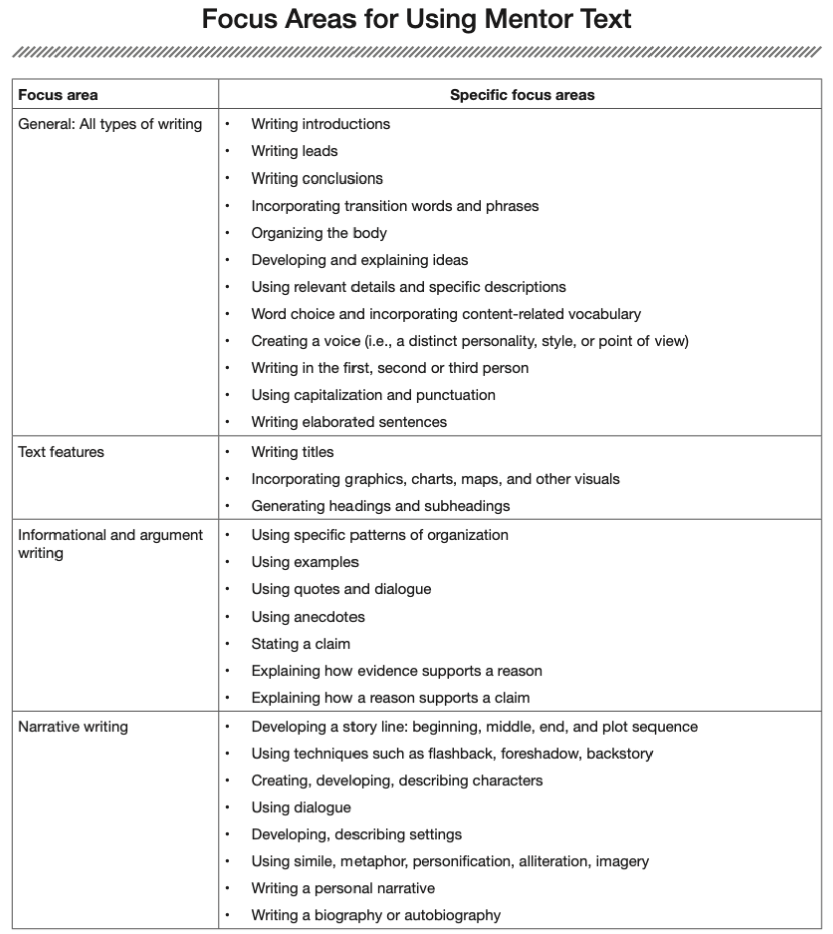
Focus Areas for Using Mentor Text
Teachers may use mentor text broadly—for example, to teach students the differences among informational, opinion, and narrative writing—or more specifically to teach particular writing skills and techniques (i.e., writers’ moves). The figure below, from the Keys to Content Writing professional learning course (Sedita, 2020) provides examples of possible instructional focuses when using mentor texts. Depending on the instructional goal, the length of a mentor text may range from a few sentences to an entire book.
Analyzing Mentor Texts
Because many students are unsure what to look for in mentor texts, they benefit from explicit instruction in how to analyze them. Students need teachers to identify the writing strategy or technique being modeled and guide them in examining how the author used it.
The following procedure can be used:
- Model the analysis. The teacher uses a think-aloud to model the process, verbalizing thoughts and actions while analyzing a text. This includes reading portions of the text aloud and pausing to consider how and why the author chose particular words, sentence structures, organizational patterns, or other techniques.
- Provide guided practice. Students work collaboratively with a partner to emulate the strategy or technique in their own writing.
- Support independent application. As students gain proficiency, they incorporate the strategy or technique consistently and independently in their own writing.
The ultimate goal is for students to learn how to analyze mentor texts independently and to read like writers.
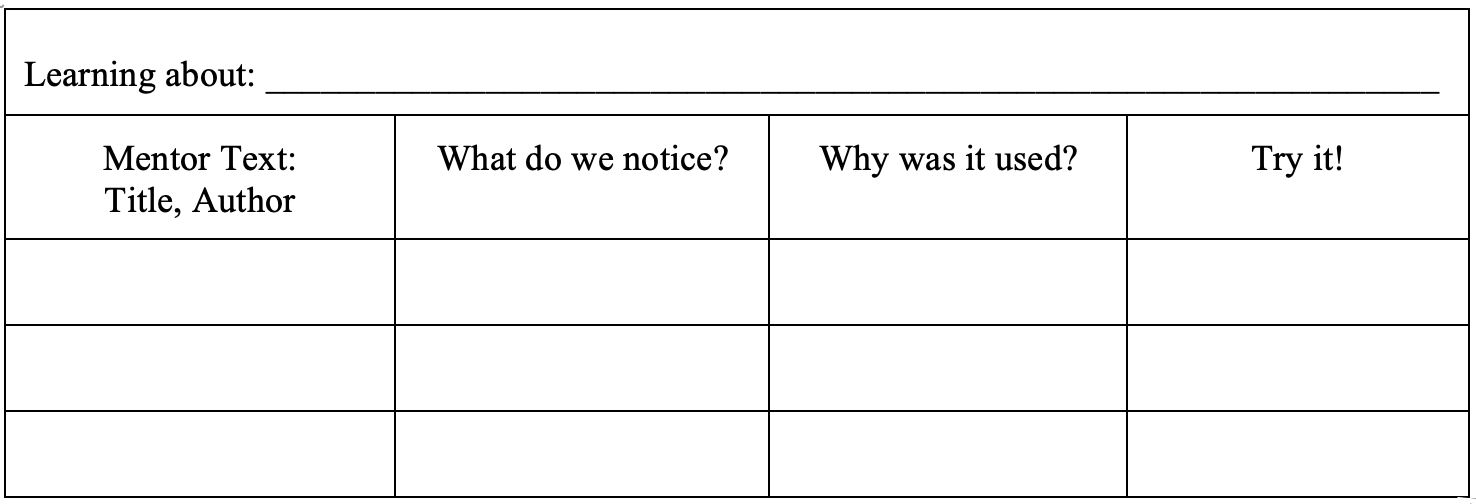
The figure below, from the Keys to Early Writing professional development learning course (Sedita, 2021), is an example of an anchor chart that can be used to during a mentor text lesson to list multiple texts that highlight the same writing skill or technique.
References
Graham, S., & Perin, D. (2007). Writing next: Effective strategies to improve writing of adolescents in middle and high schools – A report to Carnegie Corporation of New York. Alliance for Excellent Education.
Graham, S., Bollinger, A., Booth Olson, C., D’Aoust, C., MacArthur, C., McCutchen, D., & Olinghouse, N. (2012). Teaching elementary school students to be effective writers: A practice guide (NCEE 2012- 4058). National Center for Education Evaluation and Regional Assistance, Institute of Education Sciences, U.S. Department of Education.
Sedita, J. (2020). Keys to content writing (4th ed.). Keys to Literacy.
Sedita, J. (2021). Keys to early writing. Keys to Literacy.
Joan Sedita
 Joan Sedita is the founder of Keys to Literacy and author of the Keys to Literacy professional development programs. She is an experienced educator, nationally recognized speaker and teacher trainer. She has worked for over 35 years in the literacy education field and has presented to thousands of teachers and related professionals at schools, colleges, clinics, and professional conferences.
I was pleased to read your blog about mentor texts and was wondering if you knew about my book, titled Writing, Imitation and Performance: Insights from Neuroscience Research, published by Routledge.
The book reconsiders imitation as a valuable pedagogical approach in Writing Studies. Countering concerns about product-oriented teaching, formulaic writing, paternalistic or elitist pedagogy, and plagiarism, the book maintains that the use of imitation can offer a writer greater insight and help to develop a clear writerly identity. It emphasizes that imitation can provide students with opportunities to perform habitually as writers, readers, and critical thinkers, and also includes suggestions for classroom application.